
blogs & News-> Blogs-> Knee Pain Beyond Age: Why Young Adults Are Facing Early Joint Degeneration!-> Doctors today are seeing people in their twenties...
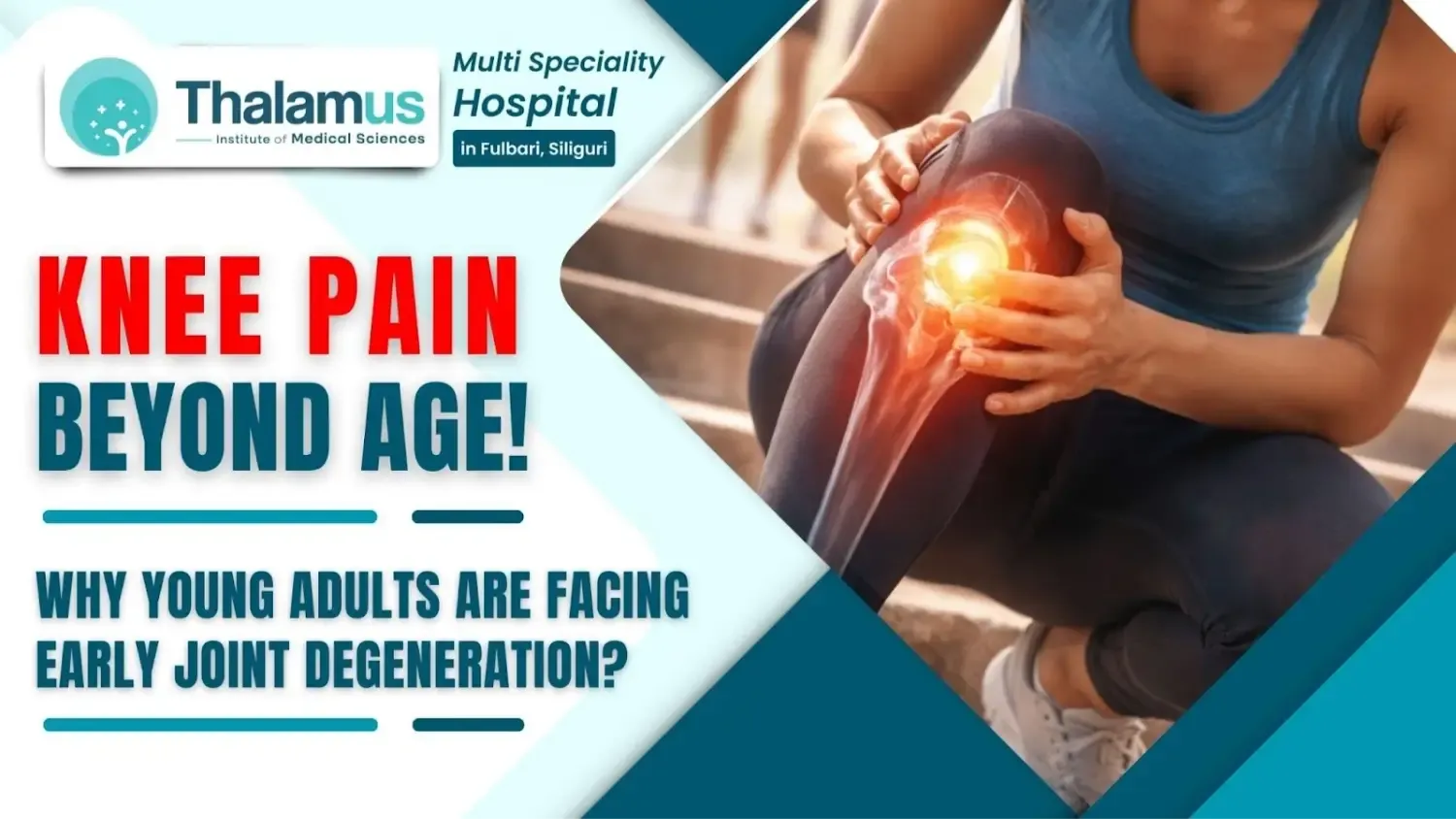
Knee Pain Beyond Age: Why Young Adults Are Facing Early Joint Degeneration!
Category: Blog | Published By: Thalamus Institute of Medical Sciences | Created: 4 months ago
Knee pain used to belong to a certain image.
Grey hair. Slow steps. A quiet complaint after a long walk.
Strangely enough, that image no longer fits.
Doctors today are seeing people in their twenties and thirties walk into clinics with knee pain that feels far too serious for their age. Some limp slightly. Others speak casually about stiffness, swelling, or a dull ache that never quite leaves. Many are surprised. A few are worried. Almost all ask the same question in different ways—why so early?
This quiet shift has become increasingly visible to orthopaedic specialists, especially at the best orthopaedic hospital in Siliguri, where younger patients are no longer rare cases. They are becoming familiar faces.
Knee degeneration, it seems, is no longer waiting for old age.
When a Strong Joint Starts to Fail Too Soon
The knee is built for endurance. It bends thousands of times a day. It carries body weight. It absorbs shock with every step taken on stairs, roads, or uneven ground.
Its strength depends on balance—smooth cartilage, proper alignment, strong surrounding muscles. When that balance is disturbed, even subtly, the joint begins to protest.
Pain may appear while climbing stairs. Or after sitting too long. Sometimes there is swelling that fades, only to return days later. At times, a faint grinding sound interrupts movement, making people pause mid-step, unsure of what they felt.
Early joint degeneration rarely announces itself loudly. That quiet beginning is often what allows it to progress unnoticed.
Injuries That Never Truly Leave
Many young adults can trace their knee problems back to a single moment.
A sports injury. A fall. A sudden twist during football, badminton, or a rushed gym session.
At the time, it healed—or seemed to. But knees remember trauma.
Ligament injuries and meniscus tears alter how pressure moves through the joint. Even when pain subsides, internal damage can change mechanics permanently. Over time, cartilage begins to thin in areas never meant to bear that load.
Orthopaedic surgeons often say an injured knee ages faster than the rest of the body. It is a sentence patients remember long after hearing it for the first time.
Weight, Pressure, and Silent Damage
Extra weight rarely announces itself dramatically. It simply adds pressure.
With every step, force travels through the knee joint. Even small weight gain multiplies that force far more than most people realise. Over years, cartilage absorbs stress it was not designed to handle.
Modern lifestyles worsen this. Long hours of sitting, followed by intense bursts of activity—weekend sports, gym workouts, sudden fitness goals. Without balance, the knee pays the price.
At the best orthopaedic hospital in Siliguri, specialists frequently explain this connection during consultations. Not as blame—but as understanding.
The Other Extreme: Too Little Movement
There is an uncomfortable contradiction here. Some knees suffer because they are overworked. Others deteriorate because they are barely used.
Sedentary routines weaken muscles that stabilise the knee, particularly the quadriceps and hamstrings. Without this support, even routine movements—standing up, walking downhill—place direct strain on the joint.
Pain appears quietly. Morning stiffness. Weakness after sitting. A sense of instability that people dismiss as tiredness.Often, it is not.
Repetition Without Recovery
Repetition without rest wears joints down.
Runners increasing distance too fast. Workers kneeling for long hours. Gym routines repeated daily without recovery time. Knees adapt silently—until they cannot.
Micro-injuries accumulate. Tendons inflame. Cartilage thins. Alignment shifts just enough to cause chronic pain.
By the time discomfort feels constant, degeneration has already begun its slow work.
Structure, Genetics, and What We Inherit
Some bodies are built with subtle differences.
Flat feet. Bowed legs. Uneven hip alignment. These structural variations change how force travels through the knee, concentrating pressure where it does not belong.
Add genetics—family history of arthritis, weaker connective tissue—and degeneration can accelerate.
These factors are not choices. But awareness matters. Early correction, proper footwear, physiotherapy, and monitoring can significantly slow damage.
This is where early orthopaedic guidance becomes essential.
Warning Signs That Should Not Be Ignored
Young adults often tolerate pain longer than they should.
Work pressure. Busy routines. The belief that discomfort will fade on its own.
It doesn’t always.
Signs that deserve attention include:
- Pain during simple movements
- Swelling after mild activity
- Stiffness after rest
- Clicking or grinding sensations
- A feeling that the knee may give way
At the best orthopaedic hospital in Siliguri, many patients admit they wish they had come earlier—not because treatment failed, but because damage could have been limited.
Expert Care That Focuses on Preservation, Not Just Treatment
Early joint degeneration does not always demand surgery. Often, it demands clarity.
Accurate diagnosis. Targeted imaging. Structured physiotherapy. Small lifestyle changes that feel sustainable rather than overwhelming.
At the best orthopaedic hospital in Siliguri, such an approach is guided by experienced specialists who prioritise long-term joint preservation—especially in younger patients.
One such specialist is Dr. Mainak Chakraborty, whose clinical practice reflects this philosophy.
Dr. Mainak Chakraborty is a Consultant Orthopaedic Surgeon with strong academic training from reputed medical institutions in India. His clinical approach is rooted in ethical, evidence-based orthopaedic care. He places strong emphasis on accurate diagnosis, patient education, and long-term functional recovery rather than short-term symptom relief.
Patients value his focus on safety, precision, and comfort—qualities that align closely with the standards expected at the best orthopaedic hospital in Siliguri.
Prevention Is Less Dramatic Than Repair
Protecting knees rarely requires extreme measures.
- Low-impact activity keeps joints nourished.
- Strong muscles stabilise movement.
- Weight control reduces unnecessary pressure.
- Proper warm-ups prevent sudden injury.
Most importantly, listening to pain—real pain, not post-workout soreness—can change outcomes.
There is wisdom in stopping before damage deepens.
Wrapping:
It can feel unsettling to realise that knee degeneration is appearing so early in life. But ignoring it will not make it disappear.
Awareness does.
Young knees are not fragile—but they are not invincible either. They respond to how they are treated over years, not days.
Seeking early guidance, especially from experienced centres like the best orthopaedic hospital in Siliguri, can mean the difference between lifelong discomfort and decades of comfortable movement.
Age should not decide how freely someone walks.
And sometimes, protecting the future begins with listening to a quiet ache today.
📞 Call us at: +91 03561-354100 | 9046005614
🌐 Visit us at: www.thalamushospital.com
Disclaimer: This blog is for educational purposes only and not a substitute for professional medical advice. If you experience any orthopaedic issues, please consult the best orthopaedic hospital in Siliguri. Avoid self-diagnosis or taking medications without medical guidance.
Book Doctor
Appointment